Obstetrics MCQs for nursing exams, with answers
Exam-style multiple-choice practice for NORCET, AIIMS, PGIMER, ESIC and state staff-nurse exams, and B.Sc / GNM obstetrics papers: Naegele’s rule, POG, GTPAL, fundal height, Bishop score, APGAR and more. Every answer is explained.
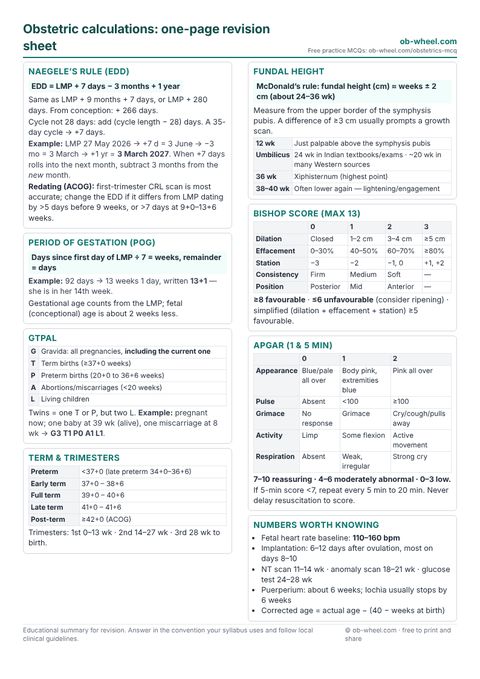
Free one-page revision sheet (PDF)
Naegele’s rule, POG, GTPAL, term definitions, fundal height (both umbilicus conventions), the Bishop and APGAR tables and the numbers worth knowing — on one A4 page. Print it, or share it with your batch.
Quick-revision formulas
- Naegele’s rule: EDD = LMP + 7 days − 3 months + 1 year (adjust by cycle length − 28). Practise EDD →
- POG: days since LMP ÷ 7 = weeks, remainder = days.
- GTPAL: Gravida, Term (≥37 wk), Preterm (20–36+6 wk), Abortions (<20 wk), Living. Decode any history →
- McDonald’s rule: fundal height (cm) ≈ weeks ±2, from about 24 to 36 weeks. Fundal height →
- Bishop: 5 items, max 13; ≥8 favourable, ≤6 unfavourable. Bishop calculator →
- APGAR: 5 signs × 0–2, at 1 and 5 min; 7–10 reassuring. APGAR calculator →
Full question bank with answers
Naegele’s rule & EDD (8)
Using Naegele’s rule, what is the EDD if the LMP was 10 June 2026?
Show answer
17 March 2027. Add 7 days (17 June), subtract 3 months (17 March) and add 1 year: 17 March 2027.
Naegele’s rule assumes a menstrual cycle of:
Show answer
28 days. The rule assumes a regular 28-day cycle with ovulation on about day 14.
Counted from the first day of the LMP, a full pregnancy lasts about:
Show answer
280 days (40 weeks). Pregnancy is dated as 280 days from the LMP; 266 days is the length counted from conception.
Counted from conception, the average pregnancy lasts about:
Show answer
266 days. Conception is about 14 days after the LMP in a 28-day cycle, so 280 − 14 = 266 days.
A woman has a regular 35-day cycle. How should the Naegele EDD be adjusted?
Show answer
Add 7 days. Add the days the cycle is longer than 28 (35 − 28 = 7). Ovulation, and so the due date, is 7 days later.
The most accurate way to establish or confirm the due date is:
Show answer
First-trimester ultrasound (crown–rump length). ACOG: ultrasound measurement of the embryo or fetus in the first trimester (up to 13 6/7 weeks) is the most accurate method.
Per ACOG, between 9 0/7 and 13 6/7 weeks the LMP due date is changed if the CRL dating differs by more than:
Show answer
7 days. ACOG Committee Opinion 700: change the EDD if the discrepancy is more than 7 days at 9 0/7–13 6/7 weeks (more than 5 days before 9 weeks).
Naegele’s rule is equivalent to:
Show answer
Adding 9 months and 7 days to the LMP. +7 days −3 months +1 year is the same as +9 months +7 days.
Gestational age (POG) (4)
92 days after the first day of the LMP, the gestational age is:
Show answer
13 weeks 1 day. 92 ÷ 7 = 13 remainder 1, so 13+1.
Gestational age is counted from:
Show answer
The first day of the last menstrual period. Gestational (menstrual) age starts on the first day of the LMP, about 2 weeks before conception.
Compared with gestational age, fetal (conceptional) age is about:
Show answer
2 weeks less. Fetal age counts from conception, roughly 2 weeks after the LMP.
A woman at 24+3 weeks is in which week of pregnancy?
Show answer
Her 25th week. 24 completed weeks plus 3 days means she is in her 25th week.
Gravida, para & GTPAL (5)
A woman pregnant for the first time is described as:
Show answer
Primigravida. Gravida counts pregnancies; a first pregnancy makes her a primigravida (she is still nulliparous until she gives birth).
In GTPAL notation, a twin birth at 38 weeks counts as:
Show answer
T = 1 and L = 2 (if both live). T and P count pregnancies (births), not babies; L counts living children, so twins add 2 to L.
A woman is currently pregnant. She had one baby at 39 weeks and one miscarriage at 8 weeks; her child is alive. Her GTPAL is:
Show answer
G3 T1 P0 A1 L1. G = 3 (including the current pregnancy), T = 1, P = 0, A = 1 (loss before 20 weeks), L = 1.
In GTPAL, “P” stands for:
Show answer
Preterm births (20 0/7 to 36 6/7 weeks). In the five-part GTPAL system P is preterm births; in two-part G/P notation P means para.
Gravida means the total number of:
Show answer
Pregnancies, including the current one. Gravida counts every pregnancy regardless of outcome, including a current pregnancy.
Fundal height (6)
At about 12 weeks the uterine fundus is first palpable:
Show answer
Just above the symphysis pubis. At around 12 weeks the uterus rises out of the pelvis and can be felt just above the pubic bone.
The fundus reaches the level of the xiphisternum at about:
Show answer
36 weeks. The fundus is highest at about 36 weeks; after that it may drop as the head engages.
In Indian nursing exams (following standard Indian obstetrics textbooks), the fundus is at the level of the umbilicus at:
Show answer
24 weeks. Indian textbooks and exam keys use 24 weeks. Many Western sources put the umbilicus at about 20 weeks — answer according to the convention your exam follows.
From about 24 to 36 weeks, fundal height in centimetres roughly equals:
Show answer
The weeks of gestation (±2 cm). McDonald’s rule: symphysis–fundal height in cm ≈ gestational age in weeks, give or take 2 cm.
A fall in fundal height in the last weeks of a first pregnancy is usually due to:
Show answer
Lightening (engagement of the head). As the head engages in the pelvis (lightening), the fundus often sinks below its 36-week level.
Fundal height measured with a tape starts from the:
Show answer
Upper border of the symphysis pubis. Symphysis–fundal height is measured from the top of the pubic bone to the top of the fundus.
Bishop score (6)
Which of these is NOT part of the Bishop score?
Show answer
Fetal heart rate. Bishop: dilation, effacement, station, consistency and position of the cervix.
The maximum possible Bishop score is:
Show answer
13. Dilation, effacement and station score 0–3 each; consistency and position 0–2 each: 9 + 4 = 13.
A Bishop score generally considered favourable for induction is:
Show answer
8 or more. A score of 8 or more (above 8 in some texts) means the chance of vaginal birth after induction is similar to spontaneous labour; 6 or less is unfavourable.
Cervical dilation of 3–4 cm scores how many Bishop points?
Show answer
2. Closed 0, 1–2 cm 1, 3–4 cm 2, 5 cm or more 3.
A soft cervix scores how many points for consistency?
Show answer
2. Firm 0, medium 1, soft 2.
Fetal station −1 or 0 scores:
Show answer
2. −3 scores 0, −2 scores 1, −1/0 score 2, +1/+2 score 3.
APGAR score (6)
The APGAR score is routinely assigned at:
Show answer
1 and 5 minutes after birth. At 1 and 5 minutes; if the 5-minute score is below 7, it is repeated every 5 minutes up to 20 minutes (AAP/ACOG).
A newborn heart rate of 80 bpm scores how many points?
Show answer
1. Absent 0, below 100 bpm 1, 100 or more 2.
Pink body with blue hands and feet (acrocyanosis) scores:
Show answer
1. Blue or pale all over 0, acrocyanosis 1, completely pink 2.
Per AAP and ACOG, an APGAR score of 7–10 is:
Show answer
Reassuring. 7–10 reassuring, 4–6 moderately abnormal, 0–3 low.
The ‘G’ in APGAR stands for:
Show answer
Grimace (reflex irritability). Appearance, Pulse, Grimace, Activity, Respiration.
Which statement about the APGAR score is correct?
Show answer
It should not be used to decide whether to start resuscitation. Resuscitation starts before the 1-minute score is given; the score alone does not predict long-term outcome.
Term, trimesters & screening (7)
According to ACOG, ‘full term’ is:
Show answer
39 0/7 to 40 6/7 weeks. Early term 37 0/7–38 6/7, full term 39 0/7–40 6/7, late term 41 0/7–41 6/7, post-term 42 0/7 onwards.
A birth before 37 completed weeks is:
Show answer
Preterm. Preterm is before 37 0/7 weeks; late preterm is 34 0/7–36 6/7.
Post-term pregnancy begins at:
Show answer
42 0/7 weeks. ACOG defines post-term as 42 0/7 weeks and beyond.
The nuchal translucency scan is done at:
Show answer
11 to 14 weeks. NT is measured at about 11 0/7 to 13 6/7 weeks, usually with blood tests as combined screening.
The glucose challenge test for gestational diabetes is usually done at:
Show answer
24 to 28 weeks. Routine screening for gestational diabetes is at 24–28 weeks (earlier if high risk).
Home pregnancy tests detect which hormone?
Show answer
hCG. Human chorionic gonadotropin is made from implantation onwards and appears in urine.
Implantation most often occurs how long after ovulation?
Show answer
8 to 10 days. Wilcox et al. (NEJM 1999): range 6–12 days, 84% on days 8–10.
Puerperium & newborn (5)
The normal fetal heart rate baseline is:
Show answer
110–160 bpm. A normal baseline fetal heart rate is 110 to 160 beats per minute.
Quickening refers to:
Show answer
The first fetal movements felt by the mother. Quickening is the first perception of fetal movement, usually in the second trimester and earlier in later pregnancies.
The puerperium lasts about:
Show answer
6 weeks after birth. The puerperium is the roughly 6-week period after birth while the body returns towards its non-pregnant state.
Lochia rubra (red lochia) is seen during:
Show answer
The first 3–4 days after birth. Lochia is red (rubra) for the first few days, then pinkish-brown (serosa), then yellowish-white (alba); it usually stops within about 6 weeks.
‘Corrected age’ for a baby born at 32 weeks who is now 16 weeks old is:
Show answer
8 weeks. Corrected age = actual age − weeks born early: 16 − (40 − 32) = 8 weeks.
Frequently asked questions
Are these questions from real NORCET or AIIMS papers?
No. They are original exam-style questions on the obstetric calculations and definitions that nursing entrance and staff-nurse exams commonly test. Every answer has an explanation and is checked against ACOG, AAP and standard textbook conventions.
How many questions are there?
47 fixed questions with answers below, plus unlimited calculation questions (EDD, POG, GTPAL, Bishop, APGAR and fundal height) generated fresh every round.
Why does the umbilicus question say 24 weeks?
Indian obstetrics textbooks and exam keys place the fundus at the umbilicus at 24 weeks; many Western sources say about 20 weeks. The explanation notes both so you can answer in your exam’s convention.
Sources
- ACOG Committee Opinion 700 — Methods for Estimating the Due Date
- ACOG Committee Opinion 579 — Definition of Term Pregnancy
- Bishop EH. Pelvic scoring for elective induction. Obstet Gynecol 1964;24:266–8
- AAP Committee on Fetus and Newborn & ACOG Committee on Obstetric Practice — The Apgar Score. Pediatrics 2015;136(4):819–22
- Wilcox AJ, Baird DD, Weinberg CR. Time of implantation of the conceptus and loss of pregnancy. NEJM 1999;340:1796–9
Last meaningfully updated: 2026-11-01.